
2026 Mid-Year Reality Check
How the year of the AI hangover is progressing, and what do we do now that the hype has officially hit a brick wall?

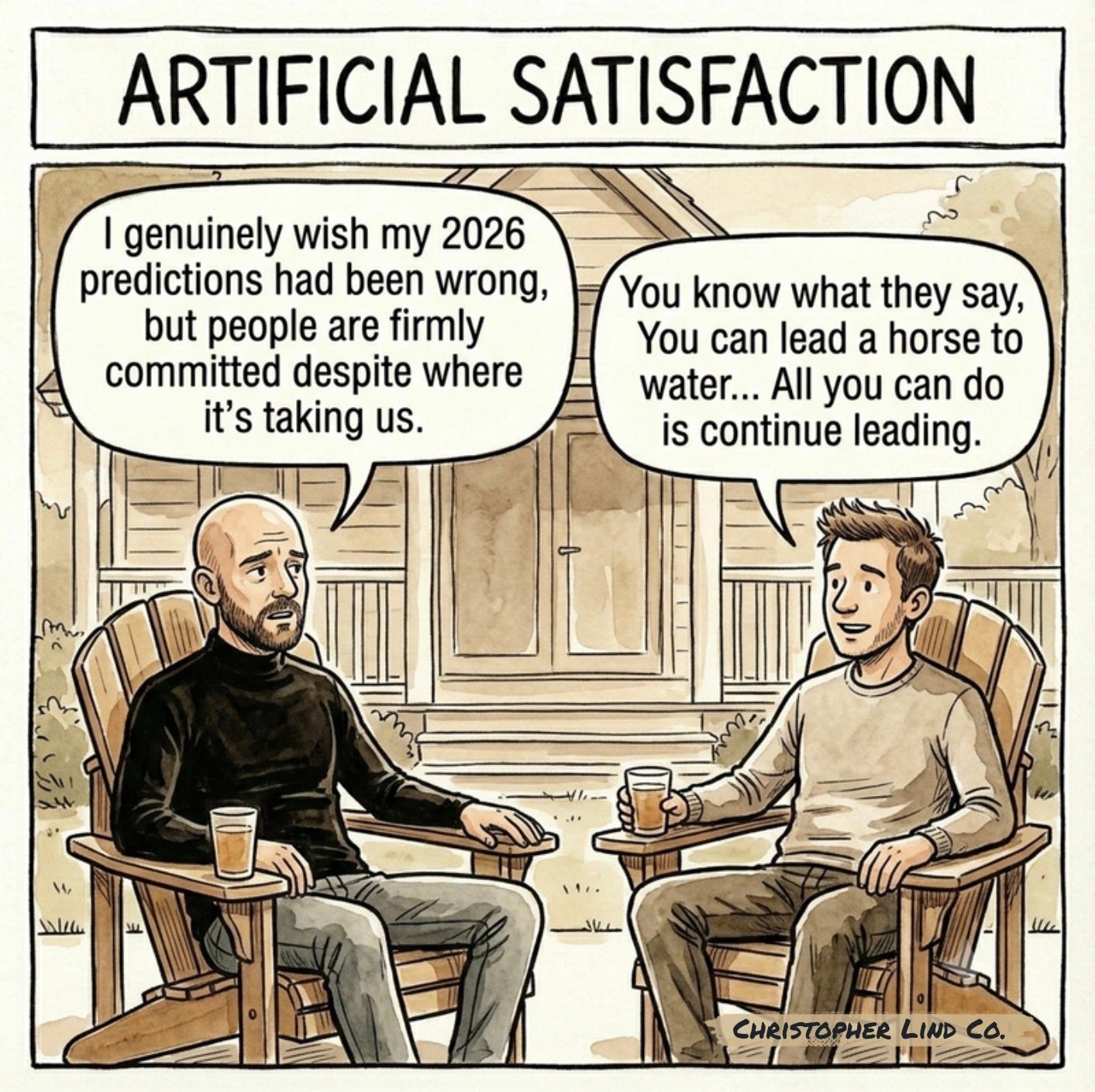
Have you ever been right about something you predicted...but really wish you were wrong? That’s the tension I’ve been feeling as we cross the mid-year mark of 2026.
If you missed it, at the start of the year I said 2026 would be the year of the “AI hangover.” I anticipated organizations would start groggily waking up, nursing a massive digital headache from their reckless, uncoordinated tech binges. Well, we’re officially here, and I can sincerely say that there’s been no satisfaction in seeing my predictions come true. In fact, many aren’t just nursing a headache. They’re staring at operational property damage, tangled tech stacks, and astronomical token bills.
Now, while the hype seems to be hitting a brick wall, the growing public backlash is missing the mark. People are publicly protesting platforms, sabotaging infrastructure, and screaming at predictive algorithms as if AI itself is a sentient villain. Unfortunately, this is shielding the real culprits because the tech isn’t the root problem. The tech is doing exactly what it’s been instructed to do, but more on that later.
In last week’s Future-Focused (you can find it on YouTube, Spotify, or wherever you consume content), I performed a complete mid-year audit of all my original predictions, and I’d highly encourage you to check it out.
Typically, on Substack I do a deeper philosophical dive, and I will do some of that. However, given where we are, I felt it appropriate to do things slightly differently this week because when I look at where we’re currently headed, it’s not great. We’re drifting into hostile, tribal camps while everyone learns incredibly hard lessons the hard way. More importantly, we’re at a point where we can’t just think about this problem anymore. We have to change our trajectory before the roof caves in.
With that, let’s get into it!
Oh, quick note from editor Christopher before we get rolling. For those who have been following me for a while, you know I rarely make an appearance. However, I just did a complete overhaul of my website. It’s updated with all the latest. Check it out, and feel free to forward it along to anyone who may find what I have to offer helpful. Thanks so much! With that, let’s get back to it.
Prediction Updates
Screaming at the Machine
“Treating algorithms as autonomous villains is blinding us to the leaders pulling the levers.”
At the beginning of 2026, I predicted that as we started assessing the damage from our late-night AI partying, we’d see a wave of regulatory crackdowns and legal accountability. Seven months in, and it seems pretty clear the legal system and political administrations are in no hurry to close the accountability gap. However, we can’t mistake that as meaning there hasn’t been any legitimate damage. The bodies are piling up everywhere, and you can see it in the headlines daily. Unfortunately, the damage combined with the massive void in formal oversight has exploded into intense anti-AI backlash. People aren’t just angry about the environmental, economic, or workplace consequences; they’re furious that absolutely nothing is being done about them.
And look, the public outrage is understandable. It demonstrates that rigorous, systemic governance is more important than ever. However, we seem to be spiraling into societal polarization, which is splitting people into hostile, extremist camps where blind accelerationists and hyper-skeptics are simply lobbing ideological grenades at each other rather than demanding solutions to the real problems. Tragically, this infighting is preventing the very accountability we desperately need, and we need to snap out of it. When we treat predictive algorithms as sentient villains, we waste our collective energy screaming at something fundamentally incapable of addressing the problem.
I appreciate why people are so upset, but we have to stop fighting with each other and shouting at machines. We aren’t going to make any meaningful progress until we start focusing on the people hiding behind the technology.
Agency Sleight-of-Hand
“We publicly sabotage visible tech while quietly surrendering our human agency behind closed doors.”
Another of my predictions was that 2026 would mark the era of “invisible AI,” in which the technology would quietly fade into the background of our daily lives. I specifically called out how this could be fueled by the acceptance of AI devices and consumer wearables. If you were to skim today’s headlines, you might think this prediction was a total miss, and it definitely didn’t play out quite how I expected. Public resistance appears to be winning. There are countless stories of people cutting down Flock cameras or mocking and ripping AI glasses off the faces of “glassholes.” Employees are openly revolting against algorithmic monitoring, and data poisoning is a rising trend. It looks like a full-scale societal rejection.
However, something interesting is happening. You’ll miss it if you’re not paying attention. Behind closed doors, AI dependency is rising as people openly invite AI into the most intimate parts of their lives. We may be screaming at it in public, but we’re quietly transferring some of our most human capabilities to invisible models. At work, executives are leaning on AI for their core business strategies while overwhelmed employees are handing off their work to autonomous agents just to keep their heads above water. In our personal lives, many are unburdening themselves to AI therapists and treating predictive code like a close friend. Like the proverbial frog in slow-boiling water, AI is successfully going invisible while we’re distracted fighting the culture war on the sidewalks.
This mid-year checkpoint demands that we stop celebrating our surface-level resistance and ruthlessly take inventory of exactly where and how AI has integrated into our lives. If we don’t start actively drawing boundaries and safeguards, we will eventually discover we have drifted to an operational and cognitive destination we never wanted to reach, with absolutely no understanding of how we got there and no map to find our way back.
Drowning in Workslop
“Automated mediocrity is not productivity; it is an operational tax on human capability.”
I was fully anticipating an epidemic of “workslop,” and 2026 has certainly delivered. We’ve witnessed a surge in “tokenmaxxing” as organizations blindly chase speed and volume. Many have flooded their environments with vibe-coded garbage, buggy applications, and regurgitated AI noise, cranking the volume all the way up. More digital “work” is happening right now than ever before, yet there are almost no measurable improvements in the actual business value all this extra output is creating. In fact, the problems are so severe that many organizations are quietly rehiring human workers just to clean up the expensive operational mess left behind by the reckless automation experiments.
As we enter the back half of the year, we have to put a full stop on the practice of layering AI on top of broken processes, believing it will magically “fill in the gaps” in organizational dynamics leaders don’t fully understand. We also have to stop believing “more” and “faster” are quantitative metrics of success. The core problem isn’t that AI inherently generates noise; it’s that we’re incentivizing people to make noise with it. We handed incredibly powerful, expensive tools to employees with zero direction, guidance, or governance frameworks. We simply yelled at them to do “more” and are now acting surprised and frustrated when the “more” they create is automated static.
AI is an accelerant and a catalyst, amplifying whatever we choose to feed it. If we refuse to shift our focus back to human effectiveness and strategic alignment, all of these fancy technological Bentleys will drive us straight off a cliff.
Tech Stack Nightmares
“Layering AI over a chaotic architecture only accelerates the speed and cost of your organizational confusion.”
I was hoping we’d start to see companies shifting away from reckless tech binges and moving toward strategic, surgical refinement of their technology environments. Six months later, it’s clear that refinement is happening. However, it looks less like a planned, proactive procedure and more like gruesome emergency surgery. Organizations are reeling from a financial one-two punch as exploding AI costs clash violently with complex, tangled tech stacks we’ve been struggling to manage for a while. Making matters worse, every SaaS platform in the ecosystem has quietly integrated duplicative AI capabilities that snuck past traditional IT oversight. It’s a regular occurrence for an organization to have five different platforms recording the exact same meeting, storing data in five different places, and running on entirely separate, uncoordinated billing clocks.
With tech platforms desperately trying to reclaim their margins, companies can no longer afford to delay assessing and detangling their technical environments or understanding exactly where, how, and why AI is being utilized. The dam of false promises of tech advancements eventually cleaning up our existing tech mess has officially broken. It’s time to finally do the hard work. With the shift to SaaS, we had already moved our businesses onto rented infrastructure. Now, with the uncoordinated overlay of generative AI, we don’t even know how to operate the infrastructure we’re paying for. If we’re not careful, this lethal combination will put countless companies right out of business.
Kicking this can down the road is no longer a decision to accumulate a little more tech debt, hoping it will pay off in the end. It’s an existential threat to the modern enterprise.
Tech Bro FOMO
“Chasing the constant stream of overhyped platforms distracts you from building a sustainable corporate foundation.”
Another prediction was that sometime this year we’d see a shake-up to the AI hierarchy. I anticipated shifts to the players on the board as the mirage of hyper-growth collided with financial sustainability. Mid-year is tracking remarkably close, but with some fascinating nuances. Google remains largely overlooked despite its impressive capabilities. OpenAI is winning in headlines but seems determined to find new basement floors to fall through. One could make a case that Grok is on a mission into the sun, while Meta seems committed to beating OpenAI in a race to the bottom. Microsoft’s Copilot appears to have comfortably settled into a state of collective corporate “meh.” Anthropic has made plenty of headlines with its Mythos models. However, with their exploding costs, it does raise questions about why enterprise leaders are eagerly footing the bill for capabilities that the vast majority of their workforce will never actually need.
Despite all the headlines surrounding these frontier models, we are clearly hitting a wall of diminishing returns. The exponential capability curve is flattening out, which could be a good thing. Unfortunately, many leaders still operate out of pure Tech Bro FOMO, continually chasing tickets to the “cool club” rather than a commercial utility. Countless organizations are paying for massive, duplicative computing power they don’t need, cannot afford, and have no idea how to leverage effectively. In doing so, they’re actively ignoring the baseline rules of sustainable business. We seem to have forgotten that enterprise technology is supposed to scale with costs decreasing as user volume increases. Instead, these overly capable models burn through exponentially increasing compute, leaving AI companies with zero clear path to profitability while bankrupting organizations along the way.
We have to stop chasing the AI hype and focus on stable, sustainable infrastructure and mature ecosystems that will survive when the venture capital dries up, and the hype cycle finally runs out of money.
The Humanoid Delusion
“Humans are uniquely built for human things; machines should be engineered specifically for the task at hand.”
Given how complex humans really are, I predicted our collective obsession with humanoid robots would start to fade as harsh engineering realities piled up. Six months later, much of the sci-fi hype has indeed hit a wall, severely damaged by high-profile teleoperation scandals in which “autonomous” humanoids were revealed to be clunky machines remotely controlled by humans wearing VR headsets behind the scenes. That said, the illusion hasn’t completely vanished. A few deeply committed players are still stubbornly hanging in there, particularly across the APAC and JPAC regions, continuing to pump out a number of eyebrow-raising, viral use cases designed to keep the hype cycle on life support.
Interestingly, it’s been a fascinating case study in what happens when we attempt to force AI into a human form factor for the sake of novelty or self-obsession. What we’ve discovered is that humans are exceptional at being human, and robots are fundamentally not. Now, to be clear, I’m not suggesting that the convergence of AI and robotics will dwindle. We’re seeing that footprint expanding every day with the rise of aerial drones and highly specialized industrial systems. However, notice how the successful applications don’t waste energy trying to look like us. For physical AI to deliver actual economic value, it has largely had to abandon vanity projects and focus on where the real operational friction exists, deploying the right solution to the right problem.
While there’s still work to do, I’m glad we seem to be waking up from this delusion because it’s the only way AI and robotics can help solve supply chain, manufacturing, and labor bottlenecks with tools optimized for the environment, rather than tools optimized to mimic the mirror.
Concluding Thoughts
As always, thanks for sticking around to the end.
If what I shared today helped you see things more clearly, would you consider buying me a coffee or lunch to help keep it coming?
Also, if you or your organization would benefit from my help building the best path forward, visit my website to learn more or pass it along to someone who would.
I’m going to keep my final thoughts here to a minimum since I’ve already said a lot. All that to say, I’m not sure where exactly you are or what you’re grappling with right now, but if it feels overwhelming, you’re not alone. I don’t think I go a day without encountering people who share that they feel it. And, if I’m being honest, I feel that same weight myself.
Given that, let’s be intentional about working together to cut against the chaos and the division. Let’s encourage and build each other up rather than tear each other apart. And, let’s make sure we never lose sight of the things that matter most. We’ll eventually get through it, and we’ll be stronger on the other side when we finally do.
With that, I’ll see you on the other side.

>Seven months in, and it seems pretty clear the legal system and political administrations are in no hurry to close the accountability gap
The legal system is definitely moving faster than the political administration about this - the highly interesting case against Anthropic where they were fined for pirating their training materials is a very interesting turn - so pirating is not ok, but buying a copy of a book and then using it for training is considered "fair use" according to that case, and there's a multitude of cases coming that test this theory.
Politicians seem to be more dedicated to dealing with the noise from data centers, tangentially related to the AI tool development. And we're seeing some fascinating ways in which states and local governments are demanding accountability from the tech companies in building wasteful data centers, or not employing proper protocols in closed loop systems to prevent dangerous bacteria (cough...Meta...cough). If I had to put a prediction down...this is going to come to a head by the end of 2026. Either the tech bros are going to buy off the national political administration, or they are going to reveal some novel practice to distract us (instead of the much simpler idea of just spending more on the buildings to make them less wasteful upfront ::grumbles::).
>However, we seem to be spiraling into societal polarization, which is splitting people into hostile, extremist camps where blind accelerationists and hyper-skeptics are simply lobbing ideological grenades at each other rather than demanding solutions to the real problems.
Yep. Its a sign of the lack of leadership at the top, where the tech bros promote outlandish claims they can't deliver on, and the hyper-skeptics are saying WTH. But what I see as more promising is the quiet use of AI here and there to start speeding up processes. Companies are watching those first wave of companies commit all the sins, so to speak, and making much more targeted investments. Notice how it got real quiet real fast about "AI first" companies being announced? It seems the peak of the first wave was just after Allbirds announced it was becoming an AI company (rather than a shoe company) and people starting going...what are we coming to?
I did a series on beginning use of AI at my work for eight weeks - we just wrapped it up. In it, one of the weeks was "where NOT to use AI". I definitely couldn't have done that peak first wave. People would have said I was crazy. I also see the TikTok/Instagram/YouTube folks picking up great traction with "here's how to use AI to do this...and where human input is required/time to take it to a non-AI tool".
>Microsoft’s Copilot appears to have comfortably settled into a state of collective corporate “meh.”
I know a lot of people dog on CoPilot, but honestly? Its all a lot of business people need. They don't need the extra capabilities of Claude or ChatGPT. If you have a different role, that's where you can upgrade. Coders to Claude. Researchers to Perplexity. You can tell immediately when business folks are using Claude at a "meh" level - the presentations are ALL the same - or ChatGPT to do their most "meh" graphic work - the flyers are IDENTICAL no matter what the subject.
Having CoPilot analyze, prioritize, and segment my 500+ emails a day into buckets means I get through them in a few hours, not days. Then employing the different MS tools to get things automated? Bonus. I am constantly telling folks to give it a try. My opinion is that the universe for CoPilot is different because of the existing MS suite. Its not Claude or Perplexity or Grok, but it doesn't have to be. Work doesn't have to be 100% within CoPilot to be efficiently done, and having it as a partner helping me design the delegation work is slick. Its a different animal. Gemini is trying, but it just isn't the same as CoPilot, even WITH the workspace connection. I can do things in CoPilot quickly and constructively that I can't do in Gemini, like the email analysis system I designed.