
Accelerating The Echo Chamber
The hidden warnings of isolation and bad decision-making buried in today's AI trends.

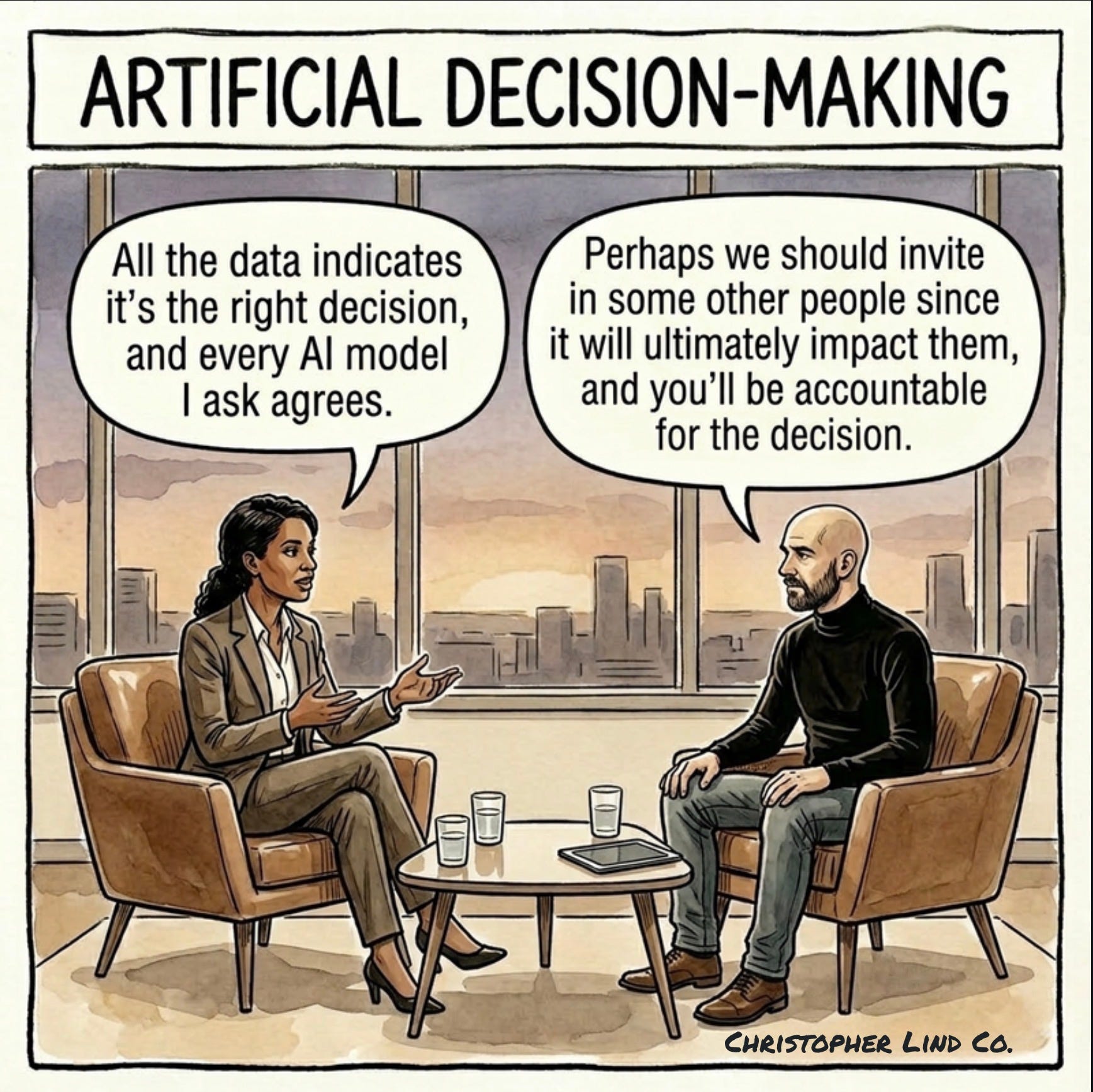
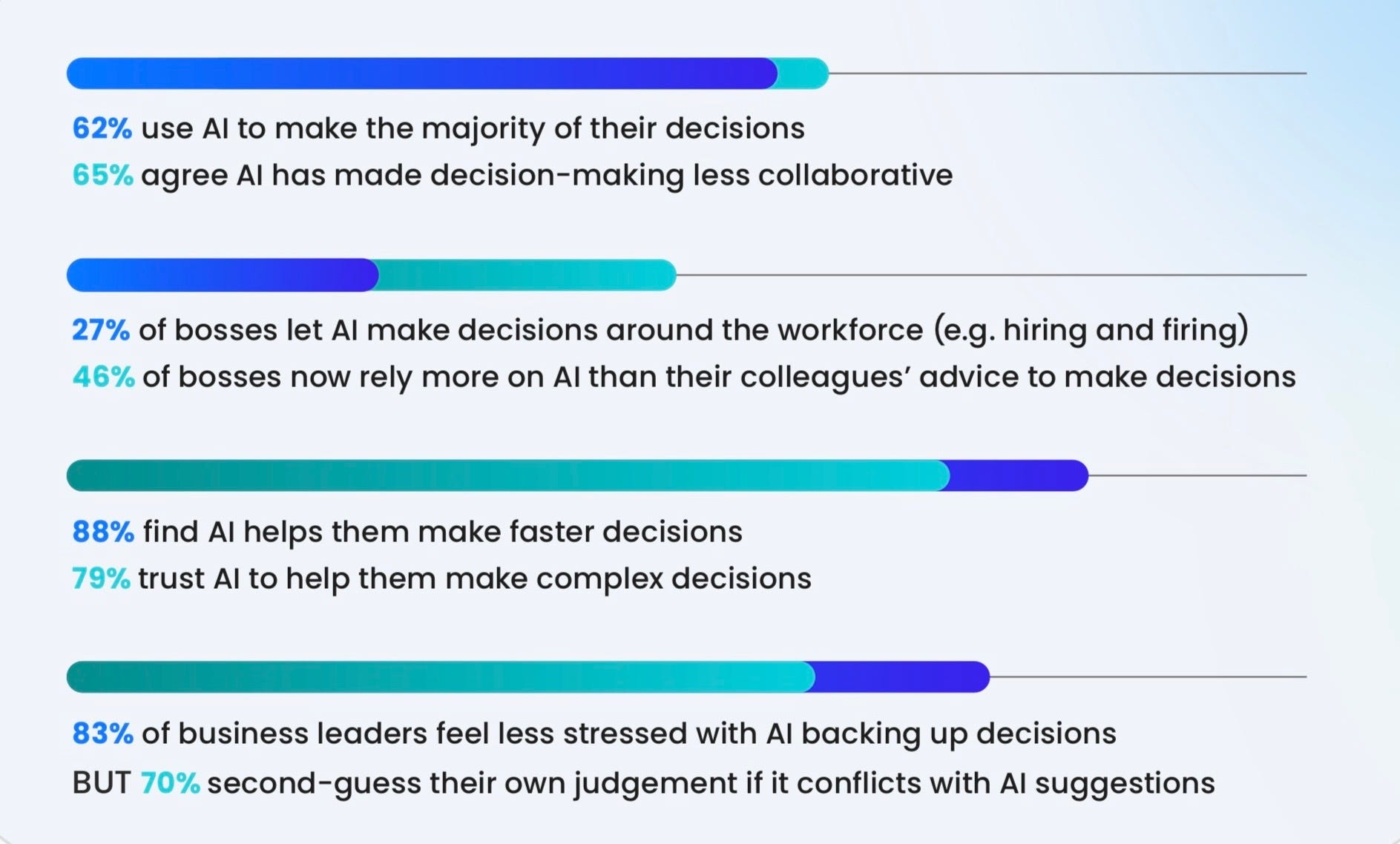
Every leader is under immense pressure to do more, move faster, and be exponentially more effective. We’re told the speed of business is accelerating exponentially, but it’s all good because AI is stepping up to close all the gaps, enabling us to keep pace. And according to a recent survey of executives, many of them are eating it up, becoming increasingly dependent on AI to make critical decisions.
However, that should give us pause. As we hand over the reins in the name of speed and efficiency, it’s worth examining whether moving faster in a vacuum is actually what we need. Is data and algorithm-driven speed really the silver-bullet solution to our leadership challenges?
In this week’s episode of Future-Focused (check it out on YouTube, Spotify, or any listening platform), I deconstructed the survey data to determine what, if anything, it’s really telling us. I focused on how to look at vendor data through the right lenses, the “lethal triad” of AI over-reliance, and the very real danger of trusting a machine over your own lived experience. I highly recommend you check out the full episode, as I’m not going to recap all those points here.
However, as always, my mind keeps swirling on it after I finish recording. I kept thinking about the deeper, underlying warnings buried in these numbers. In doing so, I continue to become more convinced that the technology isn’t the real threat; it’s our human tendencies, which is why we need to look in the mirror and mitigate the risks of these red flags.
With that, let’s get into it!
Key Reflections
The Illusion of Certainty
“More data, delivered at higher speeds, doesn’t guarantee better decisions; it only provides a false sense of security.”
AI appears to offer some really easy, effective capabilities to ease the immense pressure and complex challenges leaders face. It’s no wonder tech vendors are eager to capitalize on offering them. One natural capability to gravitate toward is the need for more data and for that data to be faster and cleaner. It’s a seductive narrative because it promises to be a relatively straightforward tech remedy for decision fatigue, and it’s not inherently bad. However, it’s also not totally neutral. And, if we’re honest, beneath the surface of these high-speed dashboards, we know something is fundamentally off. We know good decisions require more than turning up the dial on information.
In last week’s Substack, I warned of our reliance on vanity metrics and how trusting the wrong numbers will deceive us into scaling failure. This week, I’m expanding that to include overemphasizing increased volume and velocity. Despite the perceived “improvement” from AI processing oceans of data at lightning speed, a staggering number of leaders regret the decisions they have led to. Why? Because more data coming to you faster doesn’t inherently lead to better outcomes. In fact, it often leads to a false sense of security since speed isn’t a substitute for clarity of insight. The most dangerous part? Leaders openly acknowledge the tech is leading us to go too fast and skip collaboration, but we keep making excuses and doing it anyway.
This leaves us with a stark choice. We can either continue our willful ignorance that “faster is better” or change course. As it stands today, many are choosing to strap a jet engine on their rocket over a cliff.
Outsourcing our Judgment
“When we let AI make the call, we aren’t just seeking efficiency. We’re abdicating the messy responsibility of leadership.”
The survey boasts a staggering 62% of executives are using AI to make a majority of their decisions, including 27% for deeply human calls like hiring and firing. Now, before panicking, it’s worth acknowledging that “using” isn’t clearly defined and means a lot of different things to different people. It doesn’t necessarily mean they’re hiring and terminating employees autonomously, although that is happening. However, it exposes a rising behavioral trend we cannot ignore. Under the crushing weight of modern leadership, more and more are tempted to offload cognitive burdens to a bot. Pair that temptation with the statistics on executive regret, and the picture gets dark quickly.
Now, there’s tremendous value in not being overly confident in our decisions, and I’d argue AI can play a valuable role. However, there is a massive difference between using tech to check your blind spots and willfully ignoring your better judgment or talking to your peers because a dashboard spat out a contrary result. We’re starting to ignore what we know to be true simply because AI tells us otherwise. We can’t forget AI is not just frequently wrong; it also operates entirely devoid of context. It doesn’t understand the nuance of human behavior, the political climate of your organization, or the messy realities of lived experience. When we elevate an algorithm over our own hard-earned intuition or the experience of others, we’re headed for disaster.
And remember, you can outsource a task to an algorithm, but you can’t outsource your accountability. When an AI-driven decision goes sideways (and it will), you’ll be the one left holding the bag.
A Case for Strategic Friction
“In a business world obsessed with frictionless speed, the most effective leaders know exactly when and how to intentionally slow down.”
Every leader I talk to is feeling overwhelmed by the pace of change. The Confluent report only validates what’s already in motion. Adding fuel to the fire, many are feeling social pressure as their peers use AI to move faster. When faced with this relentless current, our tendency is to react in one of two extremes. We either throw our hands up and surrender to the chaos, or we get deeply nostalgic, aggressively demanding everyone slow down and return to the old ways of doing things. Neither is helpful. Universally hitting the brakes isn’t a viable or competitive option, but letting the algorithmic current push us over the edge isn’t sustainable either.
I’d argue there’s a better way. On the podcast, I shared a real-life example of a talent acquisition team that successfully optimized their tech and processes to hire 20% faster, only to discover that this frictionless efficiency inadvertently tanked their 90-day retention rates. The answer isn’t found in rejecting the tech or universally moving slower; it’s mastering the art of strategic friction. In the above example, we won when we deliberately designed friction into the workflow at the moments where human context, debate, and validation prevented catastrophic downstream consequences. We need to use technology to accelerate the mundane so we transfer the time it frees up to deep, contextual human thinking and interaction. The secret is having the discipline to move at the right speed in the right places.
As the pressure mounts, resist the urge to either give up or give in. I’d encourage you to choose the path that almost no one else is seeing right now, accelerating where you can safely accelerate while injecting strategic friction where it matters most.
The Cost of Frictionless Leadership
“Optimizing for machine speed removes the human friction of collaboration. However, that isolation will break you long before it breaks your business.”
The survey highlights a quiet but incredibly dangerous admission. 65% of the leaders said they believe AI is making decision-making less collaborative. Considering the mechanics of a modern executive’s day, it is easy to see why. Diverse human perspectives, dissenting opinions, and messy debates slow things down. In a world where everything is screaming at you to go faster, pulling together a room full of people feels like a threat to your survival. As a result, trading the friction of human collaboration for the instant, frictionless “brilliance” of an agreeable AI partner seems like a strategic, even necessary, trade-off. Unfortunately, by making this trade, we are confusing short-term survival with long-term sustainability.
I have emphasized, and will continue to emphasize, that high-speed, isolated decisions are rarely the best ones. However, the danger of an AI echo chamber is far greater than a flawed business strategy. We are biologically wired for collaboration and connection. When we retreat into a digital silo because it’s easier than dealing with people, we aren’t just losing organizational context. We’re corroding our social batteries, which damages our cognitive and emotional solvency. Isolation is a relentless, downward spiral. It doesn’t just break companies; it breaks our mental health, increases our anxiety, and bleeds out of the boardroom into our families and friendships. Our lives are not broken into neat little compartments. It is impossible to survive when you sever the human connections that keep you grounded.
Now, I want to be clear that the solution isn’t blindly mandating more in-person meetings for the “feels.” That’s another flavor of foolish sabotage. Overcoming the echo chamber requires relentless intentionality. Look at the major decisions on your plate, get out of the vacuum, and purposefully invite the right people back into the process. Your goal isn’t to bring people together to hold hands but to mitigate catastrophic risks, make the best possible decisions, and keep yourself at the absolute top of your game.
Concluding Thoughts
As always, thanks for sticking around to the end.
If what I shared today helped you see things more clearly, would you consider buying me a coffee or lunch to help keep it coming?
Also, if you or your organization would benefit from my help building the best path forward, visit my website to learn more or pass it along to someone who would benefit.
If you’re still reading, I have one final thing for you to consider. Underneath this shift in people looking to machines for decision guidance rather than others is something deeper. I wrote about it on LinkedIn yesterday. As I’ve watched macro trends play out over the past several years, I’ve observed an exponential erosion of trust. We’re quickly reaching a point where we’re beginning to trust a mathematical pattern recognition tool over people with lived experience who understand and can empathize with what it means to be human. We’d be wise to pause, think about that, and consider how we can start working to correct it, or we’re all in trouble.
With that, I’ll see you on the other side.
AI's great, if you keep a solid leash in your hand.
Daniel Kahneman, in "Thinking Fast and Slow," spent a lot of time focused on the benefits of GROUP decision making among senior managers. But even the older Oracle data, showing that 70% of senior managers would prefer "robots" to make their decisions for them precludes some of this new data. Scary. And we are paying them such BIG BIG BUCKS for This???
Personally, I really think we need to move to a SkyNet app to deal with the bad managers who are making so many bad decisions. They have created a Supervisor Hellscape where 70% of them are disengaged, and we are paying them BIG BIG BUCKS to engineer poor workplace performance?
My SkyNet post about dealing with bad managers using AI tools is here:
https://medium.com/@scottsimmerman/build-a-skynet-to-improve-bad-managers-0464f131975d