
Preparing for the Pop
Staying Grounded as the AI Bubble Reaches Its Breaking Point

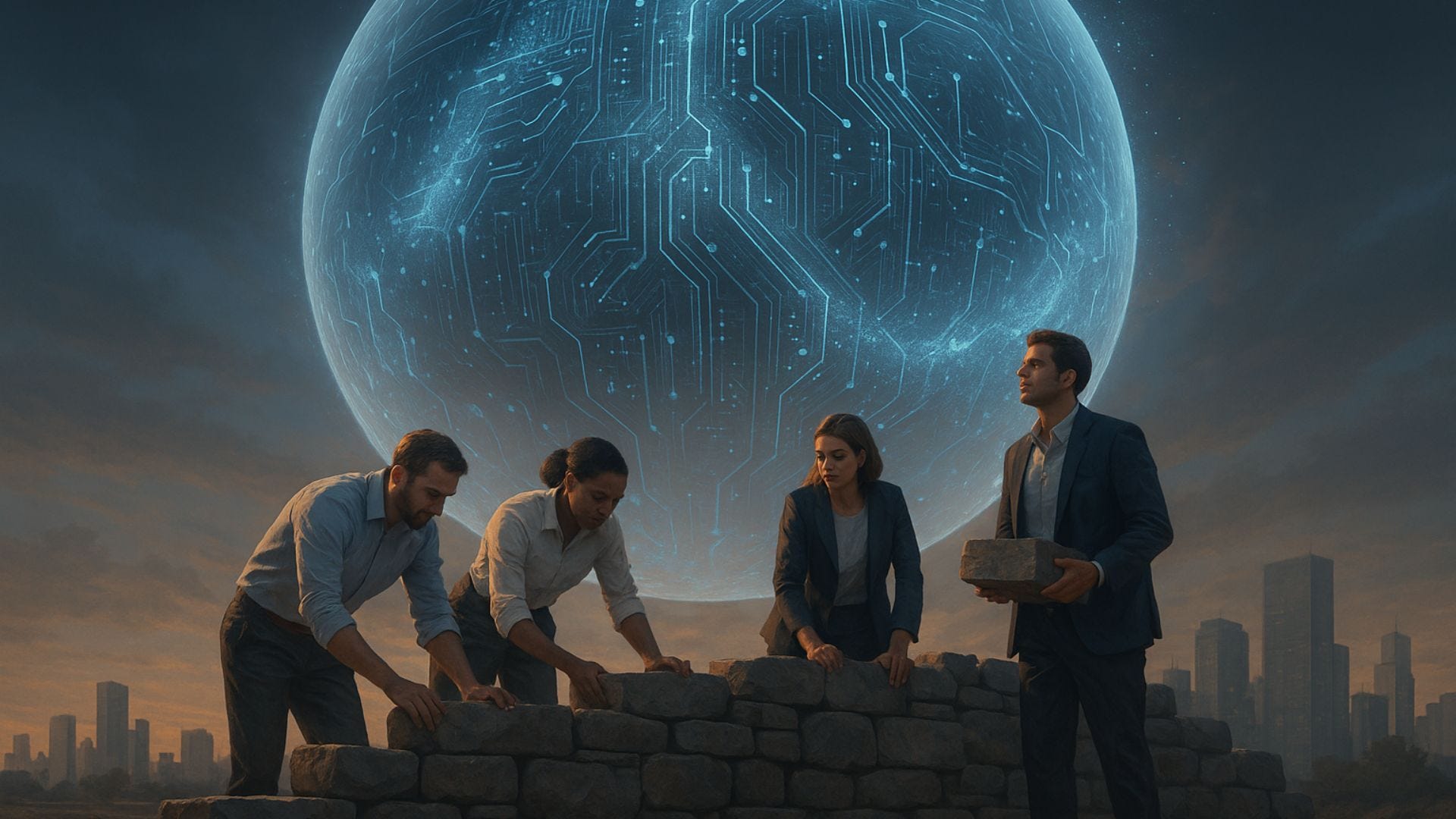
“Will it pop or not pop?”
That seems to be the question everyone’s obsessed with right now. It’s beginning to feel like the “AI bubble” has taken over every newsfeed, every earnings call, and every casual conversation about our future. Big Tech’s numbers are through the roof, valuations look unstoppable, and new AI startups are popping up faster than we can name them.
And yet, something doesn’t add up. Outside the hype, people are being laid off at unprecedented rates, hiring is in the toilet, and many can’t even afford the basics. The economy feels exceptionally shaky, and the government…well, “stable” isn’t exactly the word that immediately comes to mind. In headlines, the AI boom looks unstoppable. However, when you look around, the vast majority of people aren’t feeling a lift. They’re feeling a squeeze.
So what’s really going on with this so-called AI bubble that everyone’s talking about but few seem to understand? I made it the focus of my latest Future-Focused podcast episode, which you can find on YouTube, Spotify, or wherever you listen. In it, I unpacked some of the key factors driving this strange moment and shared three practical insights every leader should act on now.
However, as the “Big 7” announce earnings and companies like Amazon, Meta, and Target continue cutting jobs, I’ve found myself thinking even more deeply about what this all means and how we should respond. That’s why this week I wanted to go beyond the market noise and explore what this moment says about leadership, resilience, and what it really means to stay grounded when everything around us feels inflated.
With that, let’s get into it.
Key Reflections
Honor What Works While Making Room for What’s Next
“The way we’ve always done it still matters; it just can’t be the way we always do it.”
Lately, I’ve noticed how the conversations I observe about AI keep splitting into two predictable camps. On one side are the guardians of tradition, clinging tightly to everything familiar. On the other side are the disruptors who seem convinced everything familiar must be torn down so that something better can rise up. Both sides find a constant stream of validation in the noise. They’ll cite headlines, hot takes, and viral clips as “proof” they’re right. I sat in a meeting recently where people quoted completely conflicting AI “facts,” each using them as ammunition to blast each other apart. It wasn’t unusual; it’s become the new normal. In a world this loud, critical thinking is quietly disappearing, and discernment is becoming a lost art.
That’s a big problem because those two things matter now more than ever. Discernment and critical thinking are what separate wisdom from reflex and reaction. They’re what allow us to honor what’s still true without letting history trap us, to ask why something exists before determining if it still should. With all the noise about change, it’s important to remember that principles like integrity, clarity, and good judgment don’t expire. However, the ways in which we exercise them do. The leaders who thrive in moments like this are the ones willing to invite experimentation while staying grounded in purpose. They don’t worship legacy or novelty; they test, listen, and adjust.
I can assure you that meaningful progress won’t come from blindly clinging or discarding. It will come from carrying forward what deserves to last and having the humility to let the rest evolve.
Relearn the Fundamentals Before You Forget Them
“AI isn’t erasing the fundamentals; it’s just encouraging us to stop practicing them.”
A few months ago, there was a viral trend of adults trying to “skip,” something they did effortlessly as kids but now looked hilariously uncoordinated attempting. Side note, if you haven’t looked it up, I’d highly recommend it. It wasn’t just funny; it was painfully revealing. It showed how skills fade when we stop using them, and the same thing is happening right now in leadership and business. We’ve already automated, outsourced, and optimized so much that we’ve lost touch with many of the fundamentals that once made us competent. Now, that’s not inherently bad if we know what we’ve chosen to transfer, where it now lives, or whether it’s still needed. The problem is, most of us don’t.
There’s a massive difference between forgetting how to skip and forgetting how to walk. One is a loss of play; the other is a loss of basic function. In business, the same principle applies. Some capabilities can safely fade away, like manual data entry, paper workflows, and rote reporting. But others, like understanding how value is created, how systems interconnect, or how decisions ripple across teams, are foundational. When those muscles weaken, everything above them starts to wobble. We need to engage the muscles that matter with regular stretching and testing, all the while retraining the capabilities that keep the business balanced.
AI may be able to accelerate progress, but it also accelerates decay if we’re not paying attention. If we forget the fundamentals that help us walk, no amount of skipping ahead will keep us from falling.
Digital Dependencies Are Becoming Liabilities
“If you can’t function when the system fails, you’re not empowered; you’re exposed.”
A couple weeks ago, AWS went down for a few hours, and it was a jarring reminder of just how much of my day-to-day work was silently built on top of it. Some of my essential tasks were frozen; everything from video editing to scheduling to publishing stopped cold. It wasn’t just inconvenient; it was revealing. It forced me to take inventory of all the digital tools I use and assess how dependent I’ve become on them. I didn’t even realize I’d lost sight of the fact I was running significant portions of my operation on layers of invisible infrastructure I neither owned nor controlled. My systems all felt stable until they blinked.
That’s a huge vulnerability in most organizations today, and it’s something too many leaders still underestimate. Our systems will fail, APIs will break, and platforms will change terms, merge, or disappear. And, if you wait until it happens, you’ll be shaken not just by how much you’ve outsourced but also how little you understand how it all gets done. Resilience starts with “continuity literacy,” knowing what happens when a platform goes down and how to keep critical workflows alive in “safe mode.” Every leader needs a dependency map that traces the flow of work from process to platform to provider to backup. If you don’t have one, you’re trusting your business to luck.
If your organization can’t function for a day without a vendor, a model, or a cloud provider, it’s not digitally mature; it’s digitally fragile.
Asking If the Bubble Will Burst Misses the Point
“Bubbles don’t just burst; they rearrange the pieces and rewrite the rules.”
So many conversations circle back to the same question: “Will the AI bubble burst?” It’s a fair question, and I understand why so many are talking about it. However, sitting in so many executive meetings, I’m convinced it’s the wrong one to be asking. The game board has already changed far more than most people realize, quietly, dramatically, and often without anyone noticing. The very fabric of how work gets done has already been rewritten, even if it hasn’t started showing up in your spreadsheets. Whether the bubble “pops” by some technical or financial definition almost doesn’t matter. The change didn’t wait for a headline to make it official.
I was reminded of the implications the other day while helping my son with his math homework. I caught myself wondering whether he’d ever even need to do it the way he was learning. I remember when calculators felt like cheating. Now, AI can think up the questions and answer them for you. However, I didn’t tell him to skip it or outsource it. We took the time to redefine the way he approached his work instead. We worked together on understanding the context of the question and why the solution worked, not just what it was. That’s the same challenge leaders face today. The rules are changing, but the underlying principles aren’t. We can’t abandon the work of thinking simply because technology gives the appearance of thinking faster.
So maybe the better question isn’t whether the bubble will burst, but what will remain when it does. The leaders who thrive in the aftermath won’t be the ones who predicted the pop. They’ll be the ones who kept thinking while the rest of the world waited for a signal to tell them what comes next.
Concluding Thoughts
As always, thanks for sticking around to the end.
If what I shared today helped you see things more clearly, would you consider buying me a coffee or lunch to help keep it coming?
Also, if you or your organization would benefit from my help building the best path forward with AI, visit my website to learn more or pass it along to someone who would benefit.
As I’m wrapping up editing this, I can’t help but reflect on how familiar this all feels. While sure, AI is new and exciting, all the things we’re seeing and hearing aren’t. In some ways it’s almost strange how much history repeats itself because we refuse to learn from what it teaches us. And yet, there’s a subtle comfort in that. While it might feel like we’re spiraling and in completely uncharted territory, we’re not. And, if we’re willing to take a breath and focus on what matters, we’ll all come out okay (even if that includes a few new battle scars).
With that, I’ll see you on the other side.
It was interesting that when Amazon spazzed, I didn't even notice except that one newsletter wouldn't open. The Lord told me years ago to stay off the cloud, to keep my apps on my computer, and so on. I use AI quite a bit—but just as a research assistant and a piece maker for my AI image assemblages. I even merge the AI pieces with the normal layers in Photoshop. That way I can control the pixels better.
My life is based on creative thought. I can't afford to be dependent upon any special technology—though it would be impossible to do what I do without a computer anymore. So, I get an excellent computer and keep tight control on the AI. But that doesn't mean that I don't use the new capabilities. But my dependency is on the Lord and our relationship. He warns me about which tech to use. I'm grateful. Of course, He's been the head of my IT department since the 90s. >grin<
As a former English classroom teacher, all I can say is that what I see now is what I saw 20 years ago when you didn't need to use a dictionary to look up works, just ask google! Except that with that trade off comes a loss of critical thinking about order of operations, pronounciation, how there are different forms of the same word (verb, noun, gerund) and how that affects meaning. We can afford to lose the 200 lb oxford dictionary but...we shouldn't lose the ability to understand how it is organized, how to use it, why it is useful is different situations, when to use it and how MEANING for syntax, diction and composition is affected when we forget function. Keep up the great posts.